English


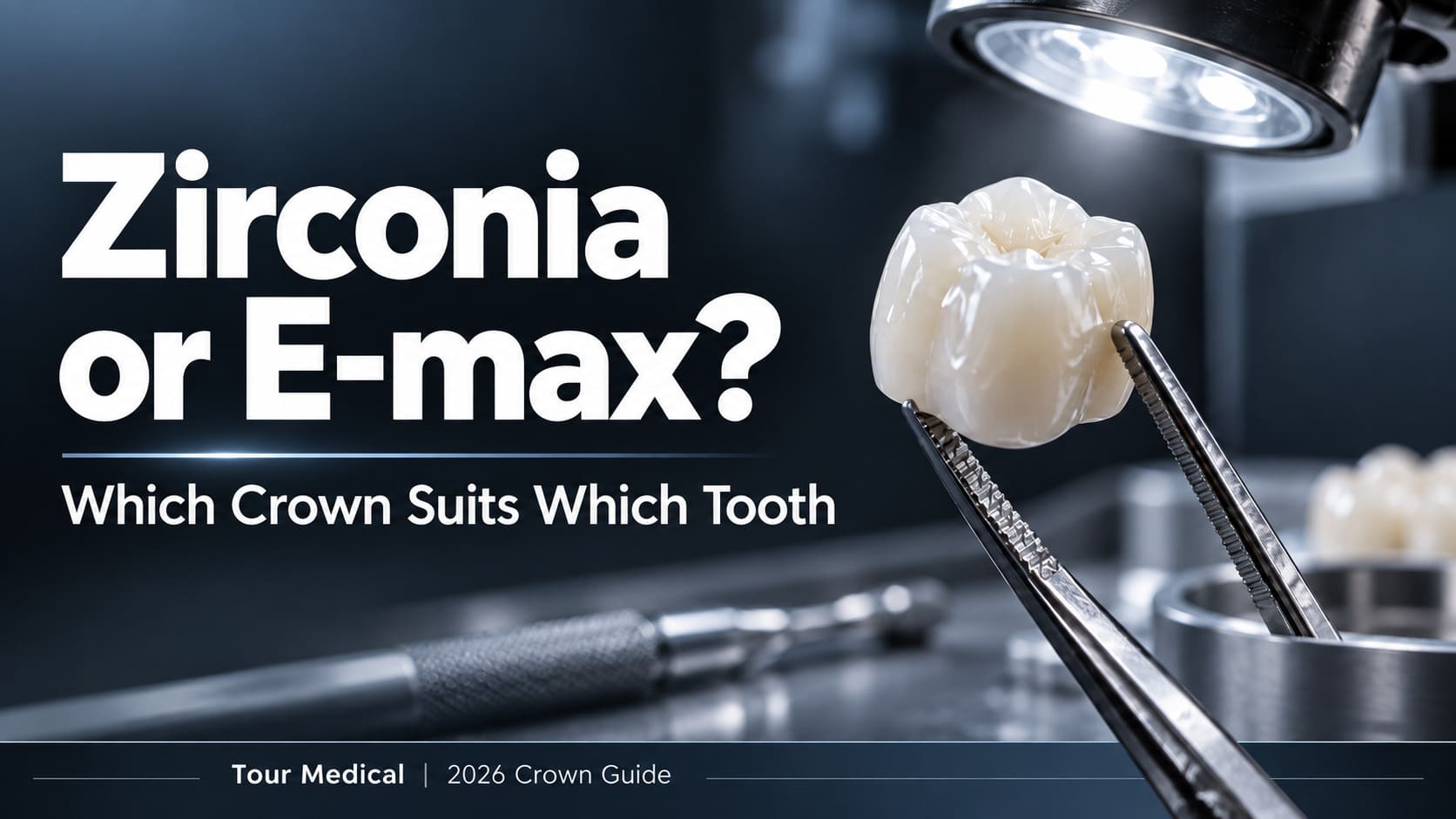
Zirconia crowns cost £130 to £220 per tooth in Turkey in 2026, against £650 to £900 in UK private practice. They are the strongest ceramic option available and the default recommendation for back teeth — but they are not automatically the right choice for the front of your mouth, and any quote that puts zirconia on every tooth is worth questioning.
What Is a Zirconia Crown?
Zirconia is zirconium dioxide, a ceramic engineered for strength rather than appearance. It replaced the older porcelain-fused-to-metal crown for most applications because it delivers comparable strength without the metal substructure — which means no grey line at the gum as the tissue recedes over the years.
Two versions exist and the difference matters more than the brand name. Monolithic zirconia is milled from a single block: maximum strength, slightly flatter appearance. Layered zirconia has a porcelain veneer fired over a zirconia core: noticeably more lifelike, marginally less durable. Which one you get should be a deliberate decision, not whatever the laboratory defaults to.
Zirconia or E-max — Which Suits Which Tooth?
The short version: zirconia for load, E-max for looks. Most well-planned smile makeovers use both, placed where each performs. A plan quoting a single material for the whole mouth is pricing, not designing.
| Zirconia | E-max (lithium disilicate) | |
|---|---|---|
| Strength | Highest available | Good, lower than zirconia |
| Translucency | Lower — more opaque | Closest to natural enamel |
| Best for | Molars, bridges, grinders | Front teeth, veneers |
| Covers dark underlying tooth | Yes — opacity is an advantage here | Less well |
| Tooth reduction needed | Slightly less | Slightly more for the same effect |
| Cost in Turkey | £130 – £220 | £160 – £260 |
One genuinely useful exception: if a front tooth is dark from an old root canal, zirconia's opacity is an advantage — E-max would let the discolouration show through.
? Been quoted a full set in one material? Send the plan and we will tell you which teeth we would change and why — free, and with the reasoning written out. Get My Free Assessment
How Much Do Zirconia Crowns Cost in Turkey?
A zirconia crown in Turkey costs £130 to £220 per tooth in 2026, compared with £650 to £900 in UK private practice. The range within Turkey reflects whether the crown is monolithic or layered and the laboratory producing it.
| Restoration | Turkey (per unit) | UK (per unit) |
|---|---|---|
| Monolithic zirconia crown | £130 – £180 | £650 – £800 |
| Layered zirconia crown | £170 – £220 | £750 – £900 |
| Zirconia bridge (per unit) | £140 – £200 | £700 – £850 |
| Zirconia on implant | £180 – £260 | £800 – £1,100 |
2026 estimates. Ask whether the quoted price is monolithic or layered — it is the single most common reason two Turkish quotes differ, and it is rarely stated unless you ask.
How Long Do Zirconia Crowns Last?
Zirconia performs well over the long term in clinical studies and is the most fracture-resistant ceramic in routine use. What ends a crown's life is rarely the ceramic itself — it is decay at the margin where the crown meets the tooth, or gum disease undermining the support beneath it.
That makes longevity mostly a hygiene question. Flossing at the margins, a night guard if you grind, and regular check-ups do more for the lifespan than the material choice does. Outcomes vary between individuals, and anyone quoting you a guaranteed number of years is describing a hope rather than a fact.
Does Zirconia Wear Down the Opposing Teeth?
This was a genuine concern with early zirconia and is worth knowing about because it still circulates. Poorly polished zirconia is abrasive against natural enamel. Modern material, properly polished and glazed, wears the opposing tooth at a rate comparable to natural enamel.
The variable is finishing quality, not the material. If a crown is adjusted at the fitting appointment it must be re-polished afterwards — an adjusted, unpolished zirconia surface is exactly the abrasive one the old research described. It is a fair question to ask any clinic directly.
How Many Days Does It Take in Kusadasi?
Allow five to seven days for a set of crowns. Preparation and digital scanning happen on day one or two, temporary crowns are fitted the same day, and the finished units are tried in and bonded around day five once the laboratory has produced them.
The try-in stage is the part worth protecting. You should see the crowns in your own mouth, in daylight, and be able to ask for a change before anything is cemented permanently. A schedule that runs from preparation straight to final cementation has removed your only opportunity to object.
Crown or Veneer — Which Do You Actually Need?
A crown covers the whole tooth; a veneer covers the front surface only. Crowns are for teeth that are damaged, heavily filled or root-treated. Veneers are for teeth that are structurally sound but wrong in colour or shape.
Crowning a healthy tooth for cosmetic reasons removes far more structure than the result requires. If your teeth are sound, laminate veneers are the more conservative route. The full range is on our zirconia crowns and dental treatments pages. Tour Medical has coordinated international patient care from Kusadasi since 2005, with more than 4,800 patients treated — and part of that is telling people when a smaller treatment would do.
✈️ Want a plan that specifies the material tooth by tooth? Book your free online assessment and we will send it itemised. Get My Free Quote
Frequently Asked Questions
How much do zirconia crowns cost in Turkey in 2026?
A zirconia crown in Turkey costs £130 to £180 for monolithic and £170 to £220 for layered, per tooth. Equivalent UK private pricing ranges from £650 to £900. Zirconia fitted on an implant costs more, typically £180 to £260.
Is zirconia better than E-max?
Neither is better overall — they suit different teeth. Zirconia is stronger and is the usual choice for molars, bridges and patients who grind. E-max is more translucent and looks closer to natural enamel, making it the usual choice for front teeth. Most well-planned cases use both.
Do zirconia crowns look natural?
Layered zirconia looks natural on front teeth; monolithic zirconia is more opaque and reads flatter, which matters less on molars where nobody sees it. If a front tooth is dark from an old root canal, zirconia's opacity is actually an advantage because it hides the discolouration.
Will a zirconia crown damage my other teeth?
Not when properly polished and glazed. Modern zirconia wears the opposing tooth at a rate comparable to natural enamel. The risk comes from an unpolished surface, which is why a crown adjusted at the fitting appointment must be re-polished before cementation.
How long do zirconia crowns last?
Zirconia is the most fracture-resistant ceramic in routine use and performs well over the long term. Crowns are usually lost to decay at the margin or gum disease rather than to the ceramic failing, so hygiene and regular check-ups affect lifespan more than the material does. Outcomes vary between individuals.
How many days do I need in Kusadasi for crowns?
Five to seven days. Preparation and digital scanning are done on day one or two with temporaries fitted the same day, and the finished crowns are tried in and bonded around day five once the laboratory has produced them.