English


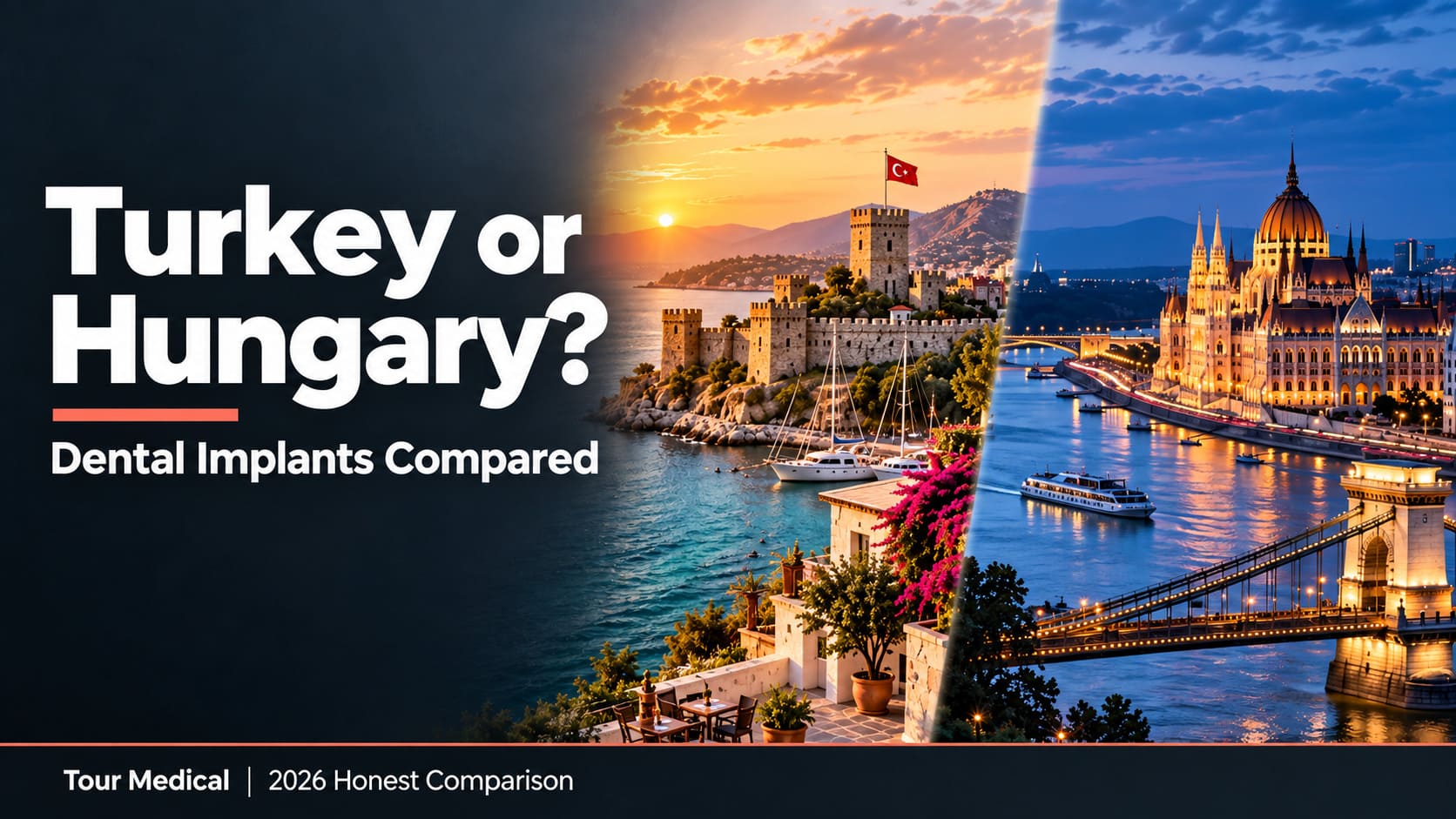
Hungary has been Europe's dental destination for thirty years and does it very well. Turkey is cheaper and warmer but further away and outside the EU. If you are choosing between them, the honest answer depends on three things: how much work you need, how far you are willing to fly, and how much the EU regulatory framework matters to you. This compares both properly — including where Hungary is the better call.
How Much Do Dental Implants Cost in Each Country?
A single implant with crown costs £350 to £650 in Turkey and £550 to £950 in Hungary in 2026. Both are far below the UK's £2,000 to £2,500. The gap between Turkey and Hungary is roughly 30 to 40 percent — real, but smaller than the gap either has with the UK.
| Treatment | Turkey | Hungary | UK |
|---|---|---|---|
| Single implant + crown | £350 – £650 | £550 – £950 | £2,000 – £2,500 |
| All-on-4 (full arch) | £3,500 – £5,000 | £5,000 – £7,500 | £12,000 – £18,000 |
| Zirconia crown | £130 – £220 | £200 – £320 | £650 – £900 |
| Bone graft (if needed) | £150 – £300 | £250 – £450 | £400 – £800 |
2026 estimates for comparison only. On a single implant the difference between Turkey and Hungary is a few hundred pounds — easily outweighed by flight cost. On a full-arch case it runs to several thousand, which is where the choice starts to matter.
Where Hungary Is the Better Choice
Being straight about this makes the rest of the comparison worth reading. Hungary is the better option in several genuine situations, and anyone telling you otherwise is selling rather than advising.
- Small treatments. One or two implants? The Turkish saving is a few hundred pounds and the extra flight cost eats most of it. Fly to Budapest.
- You want to stay inside the EU. Hungary operates under EU medical device and professional qualification directives. If that framework matters to you, it is a legitimate reason and Turkey cannot offer it.
- Nervous flyer or limited mobility. London to Budapest is around two hours twenty. London to Izmir is around four. On two trips that difference is meaningful.
- You want to drive or take the train. Hungary is reachable overland from much of Europe. Turkey realistically is not.
- Winter city break appeals more than a coast. Budapest in December is a genuinely different offer from Kusadasi.
? Not sure which side of that line you fall on? Send your treatment plan or X-ray and we will tell you honestly whether the trip to Turkey is worth it for your case — including if the answer is no. Get My Free Assessment
Where Turkey Has the Advantage
The Turkish case is strongest on larger cases and on how the trip itself is organised. It is not primarily about the headline price per tooth.
- Full-arch and full-mouth work. On All-on-4 or a full rehabilitation the saving runs to thousands, not hundreds.
- Package coordination. Turkish health tourism operates on an all-inclusive model — treatment, hotel, transfers and interpreting arranged as one thing. Hungarian clinics more often expect you to arrange your own logistics.
- Scale. Turkey receives well over a million medical tourists a year. That volume means clinics run dedicated international departments and English-speaking coordinators as standard.
- The recovery setting. Between appointments you are on the Aegean coast rather than in a city. For a ten-day trip that is not a trivial difference.
- Fewer trips for complex cases. On-site laboratories and same-visit workflows can compress work that would otherwise mean returning.
What About Regulation and Recourse?
This is the honest weak point for Turkey and deserves a straight answer. Hungary sits inside the EU framework, so implant systems, professional qualifications and patient rights all fall under directives you may already understand. Turkey is outside that framework and operates its own — the Ministry of Health's health tourism authorisation system.
In practice both regulate seriously, and the implant systems used are frequently the same CE-marked platforms in either country. But if something goes wrong, the legal route differs, and cross-border EU consumer protections that a UK patient might expect do not apply in Turkey the way they might in Hungary.
What matters more than the country, in either case, is what is written down before you travel: which implant system, what the follow-up protocol is, and what happens if a complication appears after you fly home. Ask for that in writing wherever you go.
How Long Does Each Trip Take?
Implant treatment is a two-visit process in both countries because the implant must fuse with the bone before the crown is fitted. The difference is in the surrounding logistics rather than the clinical timeline.
| Turkey | Hungary | |
|---|---|---|
| Flight from London | ~4 hours | ~2 hours 20 |
| Visit 1 (placement) | 3 – 5 days | 3 – 5 days |
| Healing gap | 3 – 6 months | 3 – 6 months |
| Visit 2 (crown) | 2 – 3 days | 2 – 3 days |
| Hotel and transfers | Usually in the package | Usually arranged separately |
So Which Should You Choose?
Work out how many units you need, then price both including flights and accommodation. That single calculation answers it more reliably than any general argument.
- One to three implants: Hungary is usually the more sensible trip.
- Four or more, or a full arch: Turkey's saving becomes substantial enough to justify the longer flight.
- Combining with other treatment: Turkey, because the multi-specialty package model is built for it.
- EU framework is a firm requirement: Hungary. That is a preference we cannot match and will not argue you out of.
If Turkey is the answer, our dental implants in Turkey page sets out what a package covers, and dental treatments shows the wider range. Tour Medical has coordinated international patient care from Kusadasi since 2005, with more than 4,800 patients treated and a reported 97% satisfaction rate — and UK patients reach a local number, +44 203 608 06 06, at every stage.
✈️ Want the two costed side by side for your actual case? Send your treatment plan and we will break it down — flights and hotel included, so you are comparing like with like. Get My Free Quote
Frequently Asked Questions
Is Turkey cheaper than Hungary for dental implants?
Yes, by roughly 30 to 40 percent. A single implant with crown costs £350 to £650 in Turkey against £550 to £950 in Hungary in 2026. On one or two implants the difference is often absorbed by the higher flight cost; on full-arch work it runs to several thousand pounds.
Is dental treatment in Hungary safer than in Turkey because it is in the EU?
EU membership means Hungary operates under EU medical device and qualification directives, which some patients value. Turkey regulates through the Ministry of Health's health tourism authorisation system, and the implant systems used are frequently the same CE-marked platforms. The practical difference is in legal recourse if something goes wrong, not in the equipment.
Which country is better for a full mouth of implants?
Turkey, on cost. All-on-4 runs £3,500 to £5,000 in Turkey against £5,000 to £7,500 in Hungary, and the saving on a full-mouth case comfortably exceeds the extra flight and accommodation cost of the longer trip.
How much longer is the flight to Turkey?
Roughly ninety minutes each way. London to Budapest is about two hours twenty; London to Izmir is about four hours. Across the two trips implant treatment requires, that adds around six hours of flying in total.
Do I need a visa for either country?
Requirements change and depend on your nationality, so check the current guidance for your passport before booking either trip. Confirm entry requirements before you pay any deposit rather than after.
Can I get treatment in Hungary and follow-up in Turkey, or the other way round?
It is possible but rarely advisable. Implant systems differ between manufacturers, and a clinic asked to restore another clinic's implant needs the exact system and size on record. If you are splitting treatment across countries, obtain full written material details before you leave the first clinic.