English


"Turkey Teeth": The TikTok Backlash, the Real Risks, and How to Actually Get It Right
If you've spent any time researching a smile makeover abroad, you've run into the term. "Turkey teeth" started as a slang label for a very specific look — bright white, uniformly straight crowns, sometimes filed down to little pegs first — and it has since become shorthand for everything that can go wrong with cut-price dental tourism.
The backlash has been loud. UK dentists have reported treating patients for complications after treatment abroad, the General Dental Council has issued formal warnings, and a British Dental Journal survey found that the large majority of UK dentists have now treated patients for complications following treatment abroad. TikTok is full of before-and-after videos showing aggressive over-preparation and clinics that look more like production lines than dental practices.
None of that means dental treatment in Turkey is inherently unsafe. It means patients need to know how to tell the difference between a properly planned smile makeover and a red-flag clinic — not after they've already had healthy teeth filed down. This is that guide.
What "Turkey Teeth" Actually Refers To
The term describes a specific outcome, not a nationality of treatment: teeth that have been aggressively shaved down — often on patients who didn't need any crown work at all — to fit uniform, over-white crowns, often veneers or crowns applied to a full arch regardless of whether every tooth actually needed it. It looks artificial because, done this way, it is.
This is not a technique unique to Turkey, and it's not what happens at every clinic there. But the volume of dental tourism to Turkey, combined with a genuine low-cost "hair-mill-style" segment of the market, means it's where this specific failure pattern shows up most often in UK dental surgeries.
Why the Backlash Is Real — and Why It's Not the Whole Story
The criticism is grounded in real clinical evidence, not just viral videos. Complications reported by UK dentists treating returning patients include nerve damage, chronic infection, bite collapse, and — most often irreversible — rows of over-prepared teeth that can never fully recover their original structure. The British Dental Association has specifically called for better regulation of dental tourism marketing and better patient education about how irreversible crown preparation actually is.
At the same time, thousands of patients travel to Turkey every year and get well-planned, well-executed treatment from properly qualified, licensed specialists working in accredited clinics with modern equipment and rigorous sterilization standards. The industry isn't uniformly good or uniformly bad — it's inconsistent, and the gap between the best and worst providers is enormous. The risk isn't "Turkey." The risk is not knowing how to tell a rushed, volume-driven operation from a properly run clinic before you're already in the chair.
How to Tell the Difference Before You Book
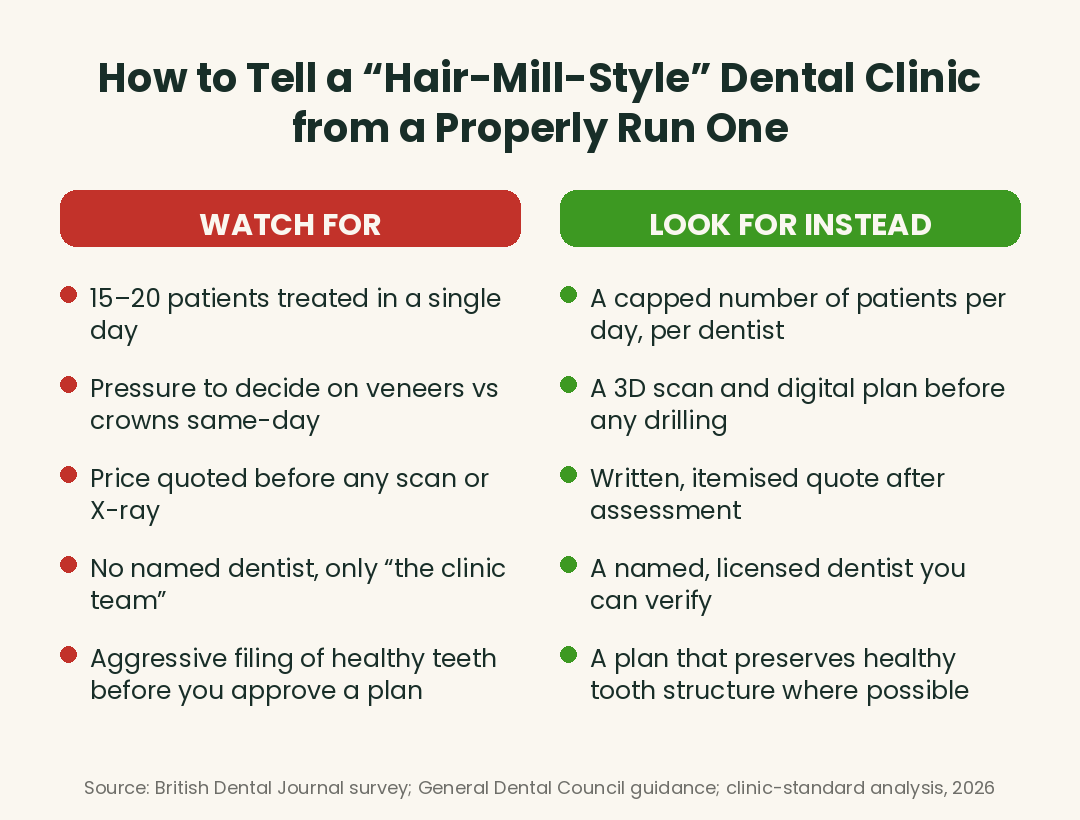
A few concrete signals separate a properly run clinic from a red-flag one:
- A full clinical exam and digital scan before any treatment plan is finalized — not a quote based on a couple of photos sent over WhatsApp.
- A named, licensed dentist you can verify — not just a clinic brand or a coordinator who fields all your questions.
- A conservative approach to healthy teeth — veneers or minimal-prep options offered where they're clinically appropriate, rather than a default full-arch crown plan for every patient regardless of need.
- Transparent pricing that reflects the actual scope of work — an unrealistically low price, especially for full-arch treatment, usually means something in the process has been cut: scanning, named specialists, aftercare, or materials.
- A clear aftercare and complications policy in writing — what happens, specifically, if you have a problem after you've flown home.
What a Properly Planned Smile Makeover Actually Looks Like
- Named, licensed clinicians. You should be able to verify your dentist's name and license, not just the clinic.
- Digital assessment first. A 3D scan and facial photography determine what your case actually needs — which may be fewer teeth treated than you expected, not more.
- Conservative tooth preparation. Not every tooth in an arch needs a crown. Veneers preserve significantly more natural tooth structure than crowns and are the right choice for the majority of cosmetic cases where the underlying tooth is healthy.
- A design you approve before any drilling. Digital smile design lets you see and adjust the plan before anything irreversible happens.
- A clear aftercare and complications policy in writing — what happens, specifically, if you have a problem after you've flown home.
Frequently Asked Questions
Is it true that Turkey teeth always look fake?
Only when the underlying approach is fake — same shape, same shade, applied regardless of your natural facial proportions. A properly planned smile makeover, using digital design and conservative preparation, produces a result that suits your face rather than a generic template.
Can bad "Turkey teeth" be fixed?
In many cases, yes, though options depend on how much natural tooth structure remains — which is exactly why aggressive initial preparation is the most serious risk, not just a cosmetic one. Revision cases are more complex and costly than getting it right the first time.
How do I check if a dentist in Turkey is properly licensed?
Ask for their name and license number directly, and confirm the clinic holds Turkish Ministry of Health authorisation for international health tourism — a legitimate clinic will provide this without hesitation.
Does a higher price always mean a safer clinic?
Not automatically, but an unrealistically low price relative to the market — particularly for full-arch work — is one of the more reliable warning signs, since it usually means something in the process (scanning, named specialists, aftercare, materials) has been cut.
Considering a smile makeover in Turkey? Send a few clear photos via WhatsApp for a free  , honest assessment from a named, licensed dentist — including whether a full-arch approach is even the right plan for your case.