English


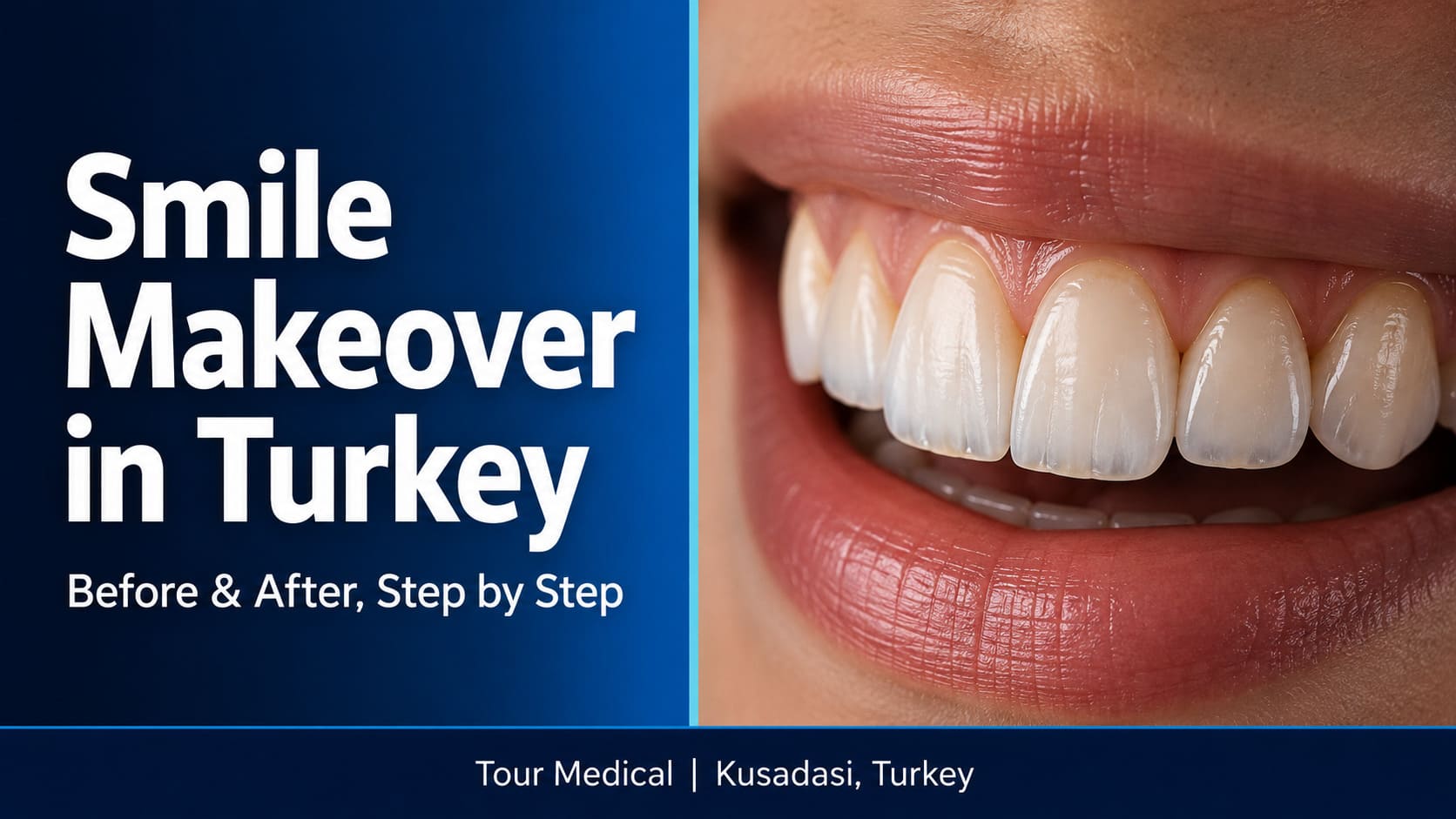
A full smile makeover in Turkey costs between £2,800 and £5,500 — around 75% less than the £14,000–£20,000 UK equivalent — and takes just five to seven days from first appointment to final fitting. But the price is only half the story. This guide walks you through the smile makeover journey exactly as it happens in Kusadasi: what each stage involves, what your teeth look like at every point, and what a realistic before-and-after result actually looks like.
What Is a Smile Makeover?
A smile makeover is not a single procedure. It is a combined treatment plan designed around your face — usually a mix of veneers, zirconia crowns, whitening, and gum contouring — with the goal of correcting colour, shape, alignment, and proportion together rather than one tooth at a time.
That is the key difference between a smile makeover and simply having a few crowns fitted. The dentist designs the whole visible smile zone — typically the front 16 to 20 teeth — as one unit, so that tooth width, length, and midline all sit correctly against your lip line and facial proportions.
| Smile Makeover Package | Turkey (Kusadasi) | UK Private | Saving |
|---|---|---|---|
| Mini makeover (8–10 upper teeth) | £1,600 – £2,600 | £6,000 – £9,000 | Up to 73% |
| Full makeover (16 teeth) | £2,800 – £4,200 | £11,000 – £16,000 | Up to 75% |
| Full makeover (20 teeth) | £3,400 – £5,500 | £14,000 – £20,000 | Up to 74% |
| Makeover + implants (combined case) | £4,500 – £8,000 | £18,000 – £30,000 | Up to 73% |
Prices shown are 2026 estimates for Kusadasi clinics and depend on the number of teeth, the material chosen, and whether preparatory treatment such as root canal work or extractions is required. Your exact figure is confirmed in writing after your free online consultation.
Which Treatments Make Up a Smile Makeover?
Most makeover plans combine two or three of the following. Your dentist selects the mix based on the condition of your existing teeth — not on a fixed package.
- Laminate veneers: ultra-thin porcelain shells bonded to the front surface. Minimal tooth reduction, best where the underlying teeth are healthy and well aligned.
- Zirconia crowns: full-coverage crowns used where teeth are heavily filled, discoloured from the inside, or structurally weak. Stronger than veneers and suitable for back teeth.
- Composite bonding: tooth-coloured resin applied directly to close small gaps or repair chips. Reversible and the least invasive option.
- Teeth whitening: often done before the makeover so that any natural teeth left untreated are colour-matched to the new restorations.
- Gum contouring: reshaping the gum line where teeth appear short or the smile shows excessive gum. Usually done with a soft-tissue laser at the preparation stage.
In practice, most UK and Irish patients at Tour Medical have a combination — for example zirconia crowns on the four heavily restored upper front teeth, laminate veneers across the remaining visible teeth, and whitening on the lower arch to match.
Not sure which combination you need? Send Tour Medical a photo of your smile and receive a free treatment plan and fixed quote within 24 hours. Request Free Consultation →
The Smile Makeover Journey: Stage by Stage
Before You Travel: Photo Assessment and Digital Preview
The journey starts before you leave home. You send standardised photographs — a relaxed smile, a wide smile, and both profiles — along with any recent X-rays if you have them. The clinical team reviews them and returns an indicative treatment plan, a shade recommendation, and a fixed all-inclusive quote.
At this stage nothing is committed. Most patients spend two to four weeks going back and forth on questions before booking, and that is exactly how it should be — a makeover is a permanent change to the way you look, and the planning conversation matters more than the price.
Day 1: Arrival, Examination and Smile Design
You are collected from Izmir Airport and transferred to your hotel in Kusadasi, usually a 75–90 minute drive along the coast. The same afternoon or the following morning you attend the clinic for a full examination: panoramic X-ray, intraoral scan, gum health assessment, and photographs.
The dentist then designs your new smile digitally, overlaying proposed tooth shapes onto a photograph of your face. This is the single most important appointment of the whole trip. You will discuss tooth length, how much of your teeth show when you speak, how square or rounded the edges should be, and — most importantly — shade. Nothing is prepared until you approve the design.
A practical tip from patients who have been through it: bring a photo of a smile you like and a photo of a smile you definitely do not like. Describing shade and shape in words is much harder than it sounds.
Day 2: Tooth Preparation and Temporary Teeth
Under local anaesthetic, the dentist reshapes the teeth that will receive crowns or veneers. For laminate veneers this means removing roughly 0.3–0.7mm of enamel from the front surface; for zirconia crowns, more of the tooth is reduced to allow the crown to seat. Digital impressions are then taken and sent to the on-site laboratory.
Before you leave, temporary acrylic teeth are fitted. These are the "before and after" moment most patients are not expecting: the temporaries are already shaped to your approved design, so you walk out of the clinic on day two with a preview of your final smile. They are more opaque and slightly bulkier than the finished restorations, but they let you test-drive the shape while you eat, talk, and photograph yourself over the next few days.
Days 3–4: Recovery, Trial Fitting and Kusadasi
Mild gum tenderness and temperature sensitivity are normal at this point and settle within a few days. These are typically the free days in the schedule — most patients use them to see Ephesus, spend time on Ladies Beach, or simply rest at the hotel.
Depending on the case, a trial fitting takes place towards the end of this window. The unglazed restorations are placed without cement so you can check fit, bite, and shade in daylight. Adjustments at this stage are routine and expected — if the shade reads too bright or a tooth edge is too square, say so. It is far easier to change now than after cementation.
Day 5: Final Fitting
The finished restorations are cemented into place, the bite is adjusted, and the margins polished. The appointment usually takes two to three hours. You are photographed again for your before-and-after record, and the clinical team goes through your aftercare protocol and written guarantee documentation.
After You Return Home
Tour Medical's coordination team checks in at set intervals during the first year. Your treatment record, materials used, and guarantee certificate are all provided in English so that your dentist at home can reference them if needed.
Before and After: What a Realistic Result Looks Like
Honest expectation-setting matters more here than anywhere else in dental tourism. A well-executed smile makeover should look like excellent natural teeth — not like a set of identical white blocks.
Natural teeth are not perfectly uniform. The two central incisors are slightly longer than the laterals; canines are a touch more prominent; the edges have subtle translucency. Good technicians build these variations in deliberately. If a before-and-after photo shows twenty identical rectangles in the brightest available shade, that is a styling choice, not a technical standard — and it is one many patients regret within a year.
What a realistic result changes:
- Colour: uniform shade across the smile zone, typically two to four shades brighter than your starting point rather than the maximum available white.
- Shape and symmetry: corrected tooth proportions, an even midline, and a smile line that follows the curve of the lower lip.
- Gaps and chips: closed and repaired, including minor crowding that would otherwise need orthodontics.
- Gum line: levelled where teeth previously appeared uneven in length.
What it does not change: significant jaw alignment problems, severe crowding, or active gum disease. These need to be treated first — and a clinic that offers to veneer over them is not one to book with.
How Long Do You Need to Stay in Turkey?
A standard smile makeover requires five to seven days in Kusadasi in a single visit. Unlike dental implants, no healing period is needed between stages, so there is no second trip in most cases.
- Veneers or crowns only: 5–6 days
- Makeover including gum contouring: 6–7 days
- Makeover combined with implants: two visits — 5–7 days for implant placement, then 5–6 days for the makeover 3–6 months later
Most UK and Irish patients book seven to ten nights, which leaves genuine holiday time around the appointments rather than a schedule that runs back to back.
Aftercare and How Long the Results Last
Zirconia crowns typically last 10–15 years and porcelain laminate veneers 10–20 years, provided the underlying teeth and gums stay healthy. Composite bonding has a shorter life — usually 4–7 years before it needs refreshing.
The variables that decide where you land in those ranges are largely within your control: daily interdental cleaning, a nightguard if you grind your teeth, avoiding using your front teeth as tools, and a professional hygiene appointment every six months. Porcelain itself does not stain, but the natural teeth and gum margins around it do.
✈️ Ready to see your own before and after? Book your free online smile consultation with Tour Medical — photo assessment, treatment plan, and fixed quote, with no commitment. Get My Free Smile Plan →
Frequently Asked Questions
How long does a smile makeover take in Turkey?
A standard smile makeover takes five to seven days in a single visit to Kusadasi. Day one covers examination and digital smile design, day two is tooth preparation and temporary fitting, and the final restorations are cemented on day five. No second trip is required unless implants are part of the plan.
How much does a smile makeover cost in Turkey compared to the UK?
A full 16-tooth smile makeover in Turkey costs between £2,800 and £4,200, compared to £11,000–£16,000 at a UK private clinic — a saving of around 75%. A 20-tooth makeover ranges from £3,400 to £5,500 in Turkey against £14,000–£20,000 in the UK.
Will a smile makeover look natural or obviously fake?
That depends entirely on the design decisions made at your first appointment, not on the country. A natural result uses varied tooth lengths, subtle edge translucency, and a shade two to four steps brighter than your starting point. You approve the digital design and test-drive the shape in temporary teeth before anything permanent is fitted.
Does a smile makeover hurt?
Tooth preparation is carried out under local anaesthetic and is not painful. Most patients report mild gum tenderness and temperature sensitivity for two to four days afterwards, managed with standard over-the-counter pain relief. Sedation options are available for anxious patients.
How long do veneers and crowns from a smile makeover last?
Porcelain laminate veneers typically last 10–20 years and zirconia crowns 10–15 years with good oral hygiene and regular hygiene appointments. Tour Medical provides a written guarantee on all restorations, with the terms confirmed in your treatment documentation before you travel.