English


A hair transplant in Turkey costs between £1,200 and £3,500 all-inclusive — compared to £5,000–£15,000 at a UK clinic. Turkey performs more hair transplants than any other country in the world, with a concentration of highly experienced surgeons and specialist technicians unmatched in Europe. This guide tells you everything you need to know before booking.
Why Turkey Is the World's Leading Hair Transplant Destination
Turkey accounts for an estimated 60–70% of global hair transplant tourism. This concentration creates a feedback loop: high volume produces experienced surgeons and technicians; experienced teams attract more patients; and competitive pricing makes the destination accessible to patients who cannot afford UK private rates.
Kusadasi, while smaller than Istanbul, has established a strong reputation for hair restoration — with clinics that offer the same FUE and DHI techniques as larger city centres, more personalised patient care, and the added benefit of a coastal recovery environment.
How Much Does a Hair Transplant Cost in Turkey?
| Package | Turkey (all-inclusive) | UK Private | |---|---|---| | Up to 2,000 grafts (FUE) | £1,200–£1,800 | £5,000–£7,000 | | 2,000–3,500 grafts (FUE) | £1,800–£2,500 | £7,000–£10,000 | | 3,500–5,000 grafts (FUE) | £2,500–£3,500 | £10,000–£15,000 | | DHI technique (premium) | £2,000–£4,000 | £8,000–£16,000 | | Beard / moustache transplant | £1,500–£2,500 | £4,000–£8,000 | | Eyebrow / lash transplant | £1,200–£2,000 | £3,500–£6,000 |All-inclusive packages cover the procedure, accommodation for 2 nights, airport transfer, post-operative medications, specialist shampoo, and a 12-month aftercare protocol. Prices are 2026 estimates.
? Get your free hair transplant consultation with Tour Medical. Share your photos for a free graft count assessment within 24 hours. Request Free Consultation →
FUE vs DHI: Which Technique Is Right for You?
FUE (Follicular Unit Extraction)
FUE is the standard technique for hair transplants worldwide. Individual follicular units (groups of 1–4 hairs) are extracted one by one from the donor area (typically the back and sides of the scalp) using a micro-punch tool of 0.7–1.0mm diameter. The extracted grafts are stored in a preservation solution and then implanted into the recipient area through small incisions made by the surgeon.
FUE leaves no linear scar — only tiny circular dot marks in the donor area that are invisible once the hair regrows. It is suited to the majority of patients and allows large sessions of 3,000–5,000+ grafts in a single day.
DHI (Direct Hair Implantation)
DHI uses a specialised Choi implanter pen to extract and implant grafts in a single step — without the need to pre-make incisions in the recipient area. This reduces the time grafts spend outside the scalp, potentially improving survival rates, and allows more precise control of implantation angle and direction.
DHI is particularly suited to patients requiring high-density implantation in areas where existing hair must be preserved, such as the hairline or crown. It is typically more expensive than standard FUE and sessions are usually smaller (1,500–3,000 grafts) due to the additional precision required.
Sapphire FUE
Sapphire FUE uses sapphire-tipped blades rather than steel blades to create the recipient channel incisions. Sapphire blades are sharper and smoother, producing smaller, more precise incisions with less tissue trauma. The result is reduced scabbing, faster healing, and denser implantation. It has become the standard at premium Turkish hair transplant clinics.
How Many Grafts Do I Need?
Graft requirements depend on the extent of hair loss, the density of the donor area, and the coverage goal. As a general reference:
- Hairline recession (early Norwood 2–3): 1,000–2,000 grafts
- Moderate thinning (Norwood 3–4): 2,000–3,500 grafts
- Significant loss (Norwood 4–5): 3,500–5,000 grafts
- Advanced loss (Norwood 5–7): 5,000–8,000 grafts (may require two sessions)
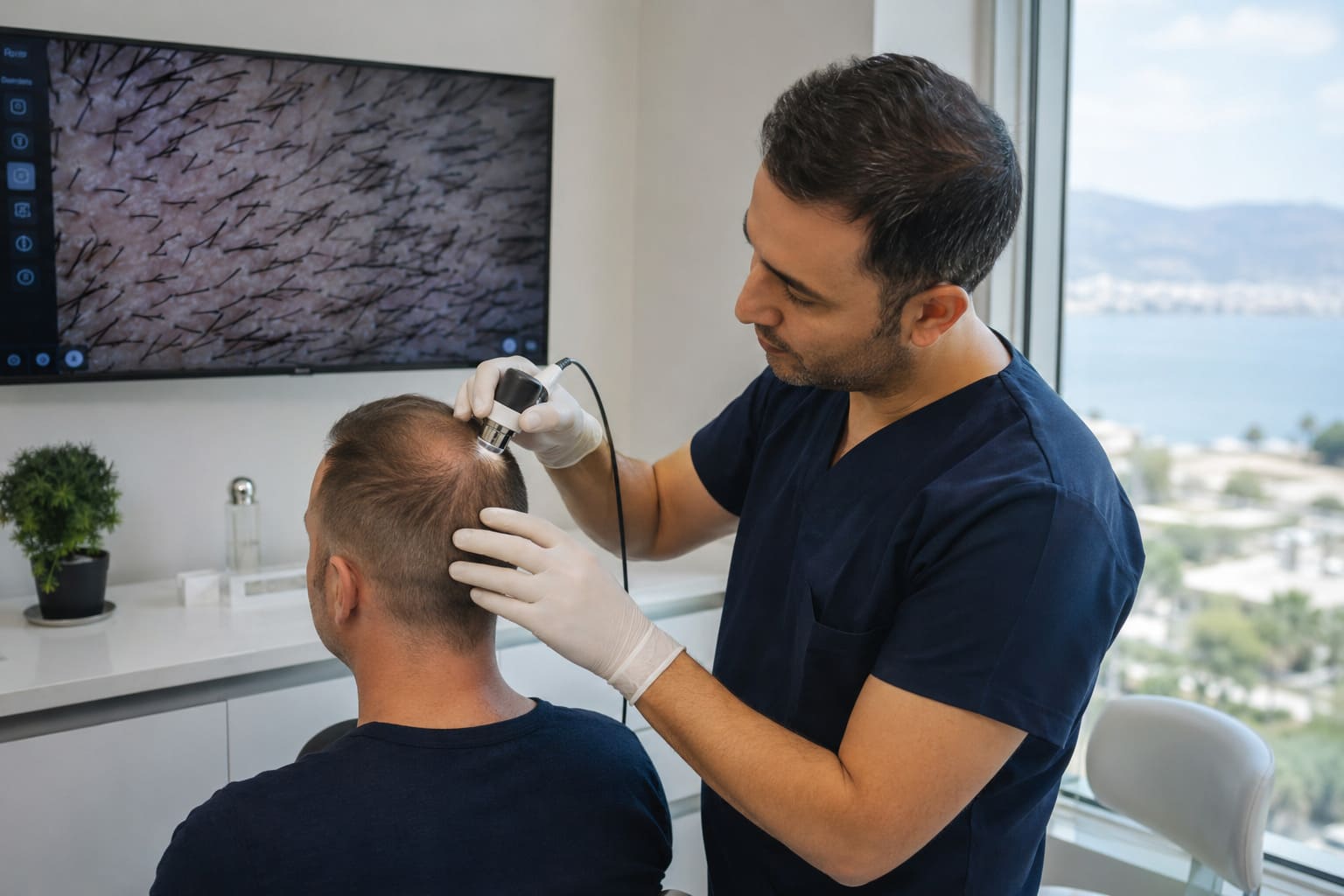
Tour Medical provides a free graft count assessment based on photographs of your scalp before you commit to travelling. A clinical graft count is also performed on arrival using a digital trichoscopy device to confirm donor density and final session design.
The Hair Transplant Process at Tour Medical: Step by Step
Before Travel: Photo Assessment and Graft Estimate
Send Tour Medical standardised photographs of your scalp — top, front, and both sides. The team provides an estimated graft count and technique recommendation within 24 hours, along with a fixed all-inclusive price.
Day 1: Arrival, Check-In and Pre-Op Consultation
You arrive in Kusadasi and are transferred to your hotel (included in the package). The same day you attend the clinic for a pre-operative consultation with the surgeon, who reviews your hairline design using digital planning software. You confirm and approve the hairline drawn on your scalp before any procedure begins.
Day 2: The Procedure
Hair transplant procedures typically last six to ten hours depending on the number of grafts. The session is carried out under local anaesthesia — you are awake but comfortable, able to watch a film or rest. The procedure is split into extraction (donor harvesting) and implantation phases, with a lunch break.
Day 3: Post-Op Check and Departure Briefing
The day after the procedure you attend a post-operative check at the clinic. The clinical team reviews the implanted area, cleans the scalp, and confirms the aftercare protocol. You receive specialist shampoo, post-op medications, and a 12-month written aftercare guide before returning home.
Hair Transplant Recovery and Growth Timeline
- Days 1–14: Scabbing forms around implanted grafts (normal and expected). Avoid touching, scratching, or wetting the recipient area beyond the protocol. Donor area heals within 7–10 days.
- Weeks 2–4: Scabs shed. Transplanted hairs begin to shed (this is normal — the follicle itself remains). Mild redness and sensitivity in the recipient area.
- Months 1–3: Resting phase — little visible change. This is the most common point at which patients worry unnecessarily. The follicles are dormant, not dead.
- Months 4–6: New hair growth begins — fine, soft hairs emerging from implanted follicles. Growth becomes progressively more visible.
- Months 6–9: Significant coverage visible. Most patients are pleased with progress at this stage.
- Month 12: Final result at approximately 80–90% density. Full final density at 18 months.
✈️ Tour Medical's hair transplant packages include hotel, airport transfer, medications, and 12-month aftercare. Request your free photo assessment today. Get My Free Graft Count →
Frequently Asked Questions
How much does a hair transplant cost in Turkey in 2026?
All-inclusive hair transplant packages in Turkey cost between £1,200 and £3,500 depending on graft count and technique. This includes the procedure, hotel accommodation, airport transfers, medications, and aftercare — compared to £5,000–£15,000 at UK private clinics where add-ons are typically charged separately.
How many grafts can be transplanted in a single session?
With FUE, experienced teams can extract and implant 3,000–5,000 grafts in a single day. DHI sessions are typically smaller (1,500–3,000 grafts) due to the additional precision required for each implantation. Patients requiring more than 5,000 grafts may be recommended two sessions.
Is the result of a hair transplant permanent?
Yes. Grafts are harvested from the permanent donor zone at the back and sides of the scalp — an area genetically resistant to DHT-driven hair loss. Once transplanted, these follicles retain their genetic programming and will not fall out due to male-pattern baldness. The transplanted result is permanent; however, native hair in non-transplanted areas may continue to thin over time, which is why ongoing medical management (minoxidil, finasteride) is often recommended alongside surgery.
Can women have hair transplants in Turkey?
Yes. Female hair loss is typically diffuse rather than pattern-based, making the donor selection more complex — but women with stable donor areas (confirmed by trichoscopy) are suitable candidates. Tour Medical's surgical team assesses female patients individually and recommends a technique based on loss pattern, donor density, and goals.
What is the difference between FUE and DHI?
FUE extracts grafts and implants them via pre-made incisions in the recipient area. DHI uses a Choi implanter pen to extract and implant in a single step without pre-made channels, allowing more precise angle control. DHI is better suited to dense packing in hairline areas; FUE allows larger single-session graft counts. Your surgeon will recommend the most appropriate technique based on your specific anatomy and goals.