English


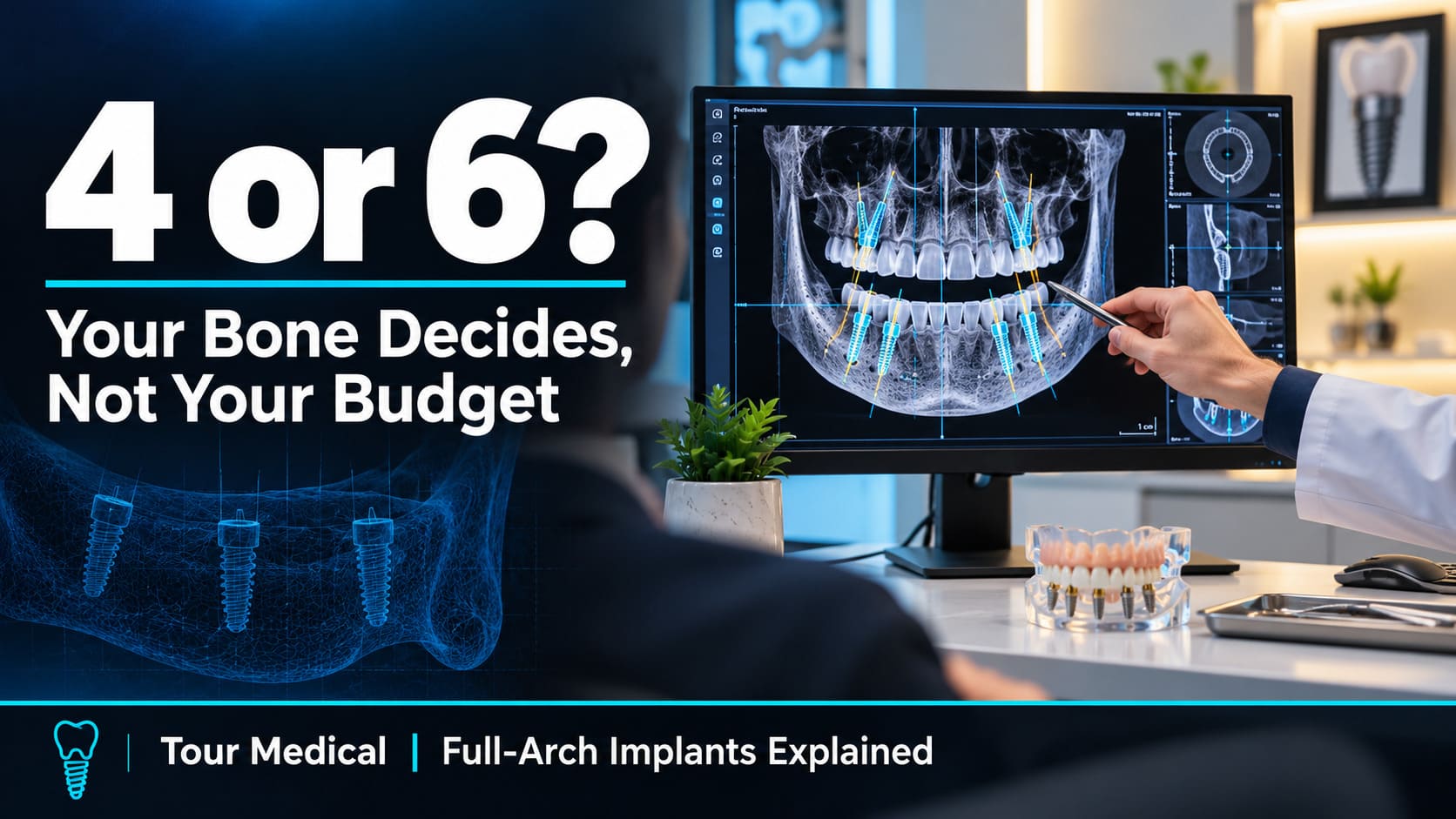
All-on-4 and All-on-6 do the same job — replace a full arch of teeth with a fixed bridge anchored on implants — and differ in how many implants carry it. What most people get wrong is treating that as a choice they make. It is a clinical finding, read off a CBCT scan of your jaw, and any clinic quoting you a number before it has seen that scan is quoting a price, not a plan.
What Is the Actual Difference?
In an All-on-4, four implants support the arch, with the two rear implants placed at an angle so they engage denser bone further forward and avoid the sinus or the nerve canal. That angulation is the whole point of the technique: it makes a fixed bridge possible without grafting in jaws that have lost bone height.
All-on-6 uses six implants, usually with less angulation, and spreads the chewing load across more anchor points and a wider span. It asks for more available bone in return.
| All-on-4 | All-on-6 | |
|---|---|---|
| Implants per arch | 4 | 6 |
| Bone required | Less — designed for reduced bone | More — needs adequate volume at more sites |
| Grafting often needed? | Frequently avoids it | Sometimes required first |
| Load distribution | Concentrated on four points | Spread across six |
| Surgery length | Shorter | Longer |
| Typical cost in Turkey | £3,500 – £5,000 per arch | £4,500 – £6,500 per arch |
2026 estimates for Turkey. The final figure depends on the bridge material more than on the two extra implants — see below.
Is More Implants Automatically Better?
No, and this is the most common misconception about full-arch treatment. Six implants placed into bone that cannot properly support them is a worse outcome than four placed into bone that can. Beyond a certain point, adding implants does not add stability; it adds sites that need enough surrounding bone to stay healthy.
The honest framing is that All-on-4 exists because it solves a problem — giving people with significant bone loss a fixed bridge without a year of grafting first. All-on-6 exists because some jaws and some bites benefit from a wider spread. Neither is the premium version of the other.
? Already have a CBCT scan or a panoramic X-ray? Send it and we will tell you which approach your bone actually supports — before you pay for anything. Get My Free Assessment
What Decides Which One You Get?
Five findings drive the decision, and all of them come from the scan and the clinical examination rather than from preference.
- Bone volume and density. The primary factor. Sufficient height and width at six sites makes All-on-6 possible; reduced posterior bone is precisely what All-on-4 was designed around.
- Which arch. The upper jaw is softer and has the sinuses to work around, so it more often calls for a different approach from the lower.
- What is opposing it. A full arch biting against natural teeth or another fixed bridge takes more force than one biting against a denture, and heavier loading favours wider support.
- Grinding and clenching. Bruxism raises the forces the bridge must absorb over years, and is a common reason to prefer six.
- Arch shape and length. A longer arch means longer unsupported spans between anchors, which changes how the load is carried.
What About the Bridge Itself?
This deserves more attention than it usually gets, because it affects both the price and how the result behaves — often more than the implant count does.
| Bridge type | Character | Usual role |
|---|---|---|
| Acrylic on a metal frame | Lighter, repairable, teeth can be replaced individually | Often the provisional; also a lower-cost final option |
| Monolithic zirconia | Harder, more resistant to wear and staining, milled as one piece | Common final choice; the main cost driver |
| Porcelain fused to zirconia | Layered ceramic for a more natural surface | Where appearance is the priority |
When you compare two full-arch quotes, check the bridge material first. A cheaper quote is frequently an acrylic final rather than a zirconia one, which is a different product — not a discount.
What Happens If One Implant Fails?
This is the fair question about All-on-4, and it has a straightforward answer. Losing one implant from a four-implant arch is more consequential than losing one from six, because the remaining three cannot usually carry the bridge on their own for long. With six, the arch may be able to function while the site is dealt with.
That is a real difference and worth weighing. It is not, however, a reason to choose six if your bone does not support six — the risk of placing implants into inadequate bone runs the other way. Ask instead what the clinic's written protocol is if an implant fails: who assesses it, what is covered, and over what period.
How Long Does Full-Arch Treatment Take?
Both follow the same shape. The first visit runs around five to seven days: assessment and CBCT, any extractions, implant placement, and a fixed temporary bridge before you fly home. The permanent bridge is fitted at a second visit of three to five days, three to six months later, once the implants have integrated.
Full-arch cases are the most frequent candidates for immediate loading, because splinting several implants together provides the stability a same-day temporary needs. Whether it applies to you is confirmed during surgery, not promised beforehand.
How Should You Compare Quotes?
Ask every clinic the same five things, and compare the answers rather than the totals: the implant system by brand, the number of implants and why that number, the final bridge material, whether the temporary is included, and the written protocol if something needs remaking.
A quote that answers all five can be compared with any other quote in the world. One that says "full mouth implants, all inclusive" cannot be compared with anything, and the gap is usually where the difference in price is hiding.
Tour Medical has coordinated international patient care from Kusadasi since 2005, and full-arch plans are reviewed against your CBCT before you travel rather than after you arrive — which is what makes the implant count a finding rather than a surprise. Our dental implants in Turkey page covers the surgical side and dental treatments in Turkey sets out what packages include. UK patients can reach a local number, +44 203 608 06 06, throughout.
? Send us any full-arch quote you have received and we will show you which of the five questions it answers and which it leaves open. Get My Free Quote
Frequently Asked Questions
What is the difference between All-on-4 and All-on-6?
Both replace a full arch with a fixed bridge on implants. All-on-4 uses four implants with the rear two angled to engage denser bone and avoid the sinus or nerve, which often removes the need for grafting. All-on-6 uses six, spreading the load more widely but requiring more available bone.
Is All-on-6 better than All-on-4?
Not inherently. Six implants placed into bone that cannot support them is a worse outcome than four placed into bone that can. All-on-4 was developed specifically for jaws with reduced bone, so the right answer depends on your CBCT scan rather than on which number sounds more thorough.
How much does All-on-4 cost in Turkey compared with All-on-6?
In 2026 All-on-4 typically costs £3,500 to £5,000 per arch in Turkey and All-on-6 £4,500 to £6,500. The bridge material affects the final figure more than the two extra implants do, so always check whether a quote covers a zirconia or an acrylic final bridge.
Who decides how many implants I need?
The surgeon, based on a CBCT scan showing bone volume and density, plus which arch is being treated, what it bites against, whether you grind your teeth, and the shape of your arch. A clinic that names a number before seeing your scan is quoting a price rather than planning treatment.
What happens if one implant fails in an All-on-4?
Losing one of four is more consequential than losing one of six, since three remaining implants cannot usually carry the bridge for long. It is still not a reason to choose six if your bone does not support six. Ask each clinic for its written protocol: who assesses a failure, what is covered, and over what period.
How long does full-arch implant treatment take?
Around five to seven days for the first visit, covering assessment, any extractions, implant placement and a fixed temporary bridge, then three to five days for the second visit when the permanent bridge is fitted, three to six months later.